


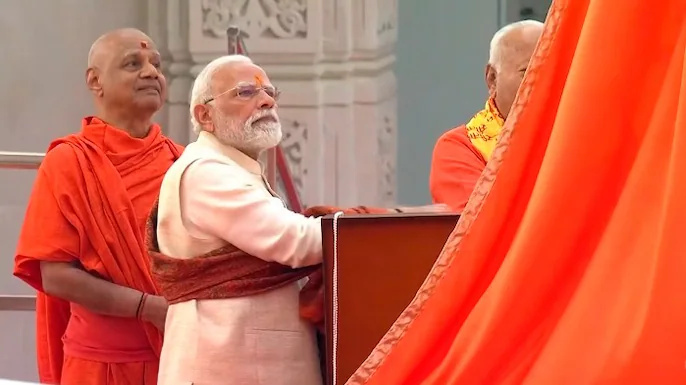
Ayodhya witnessed a landmark moment in India’s cultural and spiritual landscape as Prime Minister Narendra Modi hoisted the saffron flag at the newly built Ram Temple. Describing the occasion as a “historic turning point in India’s cultural identity,” the Prime Minister emphasized the temple’s significance in redefining national consciousness and reviving ancient Indian traditions.
The event drew thousands of devotees, saints, and dignitaries from across the nation, reflecting the deep emotional and cultural connection that millions share with Ayodhya—the birthplace of Lord Ram. With traditional chants, rituals, and a grand ceremonial atmosphere, the hoisting of the saffron flag symbolized devotion, unity, and the long-awaited realization of a centuries-old cultural aspiration.
PM Modi highlighted that the Ram Temple stands as a powerful representation of India’s spiritual awakening and cultural renaissance. He stated that the structure is not merely a temple but a symbol of universal values such as righteousness, compassion, truth, and discipline—principles embodied by Lord Ram. According to the Prime Minister, the consecration of the temple and the flag-hoisting ceremony mark the beginning of a new era rooted in cultural pride and shared heritage.
The Ram Temple’s inauguration also signifies India’s collective efforts and the perseverance of millions who awaited this moment. PM Modi acknowledged the contributions of legal authorities, devotees, and countless individuals who played a role in fulfilling this long-pending dream. He stressed that the temple would serve as a beacon of peace and harmony, attracting pilgrims from around the world and strengthening India’s position as a global spiritual destination.
Ayodhya itself is undergoing rapid transformation, with major infrastructural developments aimed at accommodating the rising influx of visitors. Newly constructed highways, improved rail connectivity, a modernized airport, and enhanced facilities around the temple town are part of the government’s broader vision to develop Ayodhya into a world-class spiritual and cultural hub.
Experts note that the Ram Temple’s completion is reshaping India’s cultural narrative. For decades, Ayodhya has been at the center of national discourse—political, social, and religious. With the temple now standing tall, it symbolizes closure, unity, and a renewed commitment to India’s civilizational values. The saffron flag hoisted by PM Modi further reinforces this message, representing sacrifice, strength, and spirituality.
The Prime Minister also reiterated that the Ram Temple will inspire future generations to stay connected to India’s timeless traditions. He urged people to view the event not merely as a religious celebration but as a reminder of India’s cultural depth and moral foundations.
As celebrations continue across the country, the Ayodhya Ram Temple remains a monumental chapter in India’s history—one that signifies cultural resurgence, national unity, and spiritual fulfillment. With the Prime Minister declaring it a pivotal moment in India’s cultural journey, the temple is set to stand as a symbol of faith, identity, and the enduring legacy of Lord Ram for generations to come.